owis · sheep
(OH-wis)
- PIEowis
- Old Englisheowu
- Todayewe
Ewe is the inherited English relative: today it specifically means a female sheep.
Proto-Indo-European · Schleicher's Fable, written the way it sounds
Spoken roughly 4500–2500 BC
A broad estimate, not an exact date. A leading theory places its speakers on the steppe north of the Black and Caspian Seas; the dates and homeland are still debated.
No surviving text records the language directly. Schleicher created this fable in 1868 as a reconstruction exercise — it is not an ancient story preserved in PIE.
Tap any word to see what it is doing.
(OH-wis, KWES-yo WUL-nah neh est, EK-wons SPEKT)
(OY-nom GWUR-um WOH-gom WEH-gon-tum)
(OY-nom-kweh MEH-gam BOR-om)
(OY-nom-kweh GMOH-num OH-koo BEH-ron-tum)
(OH-wis EK-wob-yos eh-WEW-kwet)
(KERD ag-NOO-toy moy, EK-wons AH-gon-tum WEE-rom WID-un-tay)
(EK-wos too eh-WEW-kwont: KLOO-dee, OH-way)
(NER, POH-tis, OH-wee-om WUL-nam SEB-ee GWER-mom WES-trom kwur-NEW-tee)
(NEG-ee OH-wee-om WUL-nah ES-tee)
(TOD KEK-loo-wos OH-wis AG-rom BOO-get)
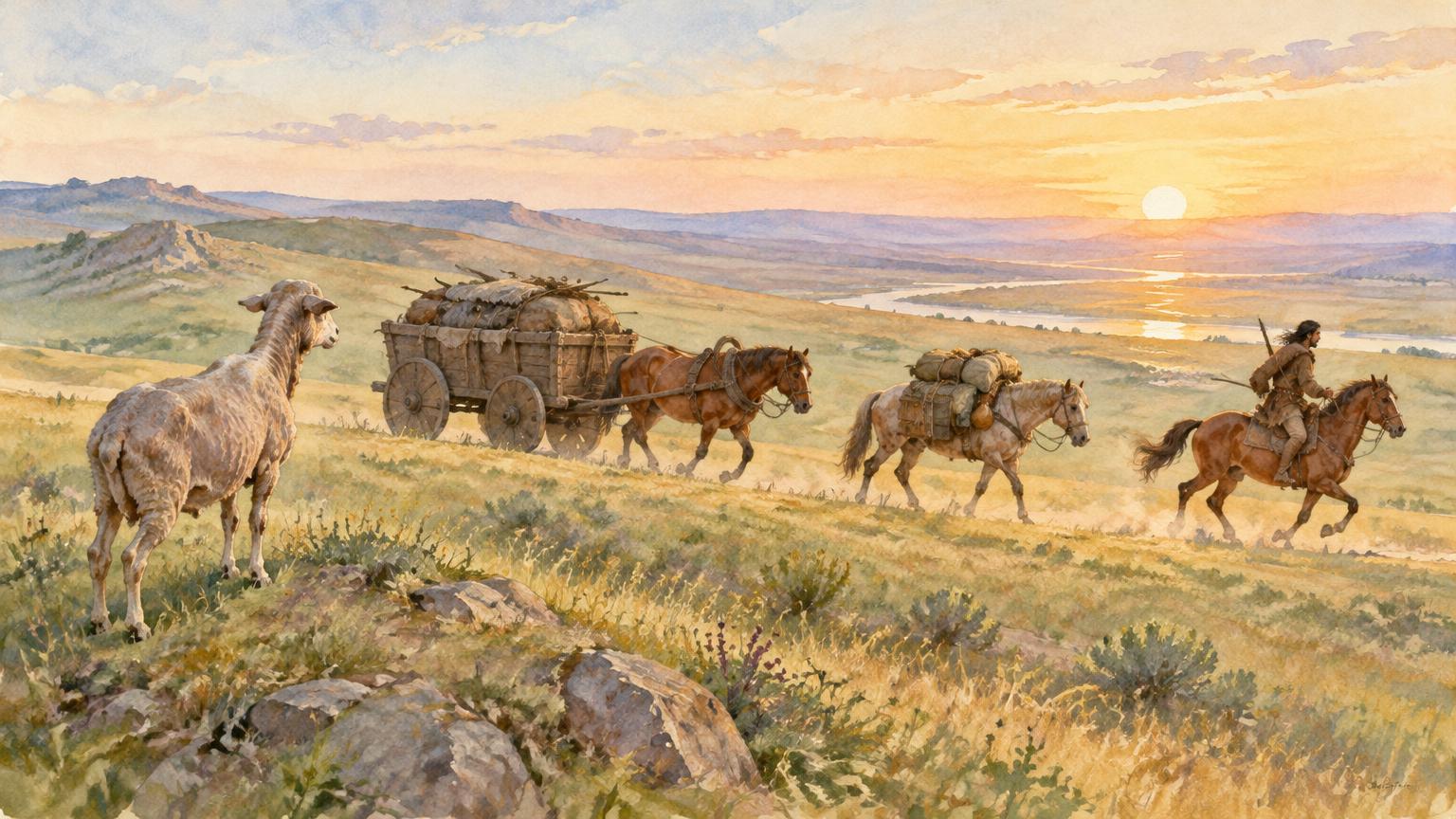
Say: A sheep that had no wool saw horses.
Owis, kwesyo wlna ne est, ekwons spekt.
(OH-wis, KWES-yo WUL-nah neh est, EK-wons SPEKT)
= A sheep that had no wool saw horses.
Oinom gwrum woghom weghontm,
(OY-nom GWUR-um WOH-gom WEH-gon-tum)
= one pulling a heavy wagon,
oinomkwe megam bhorom,
(OY-nom-kweh MEH-gam BOR-om)
= one carrying a big load,
oinomkwe ghmonm oku bherontm.
(OY-nom-kweh GMOH-num OH-koo BEH-ron-tum)
= and one quickly carrying a man.
Owis ekwobhyos ewewkwet:
(OH-wis EK-wob-yos eh-WEW-kwet)
= The sheep said to the horses:
Kerd aghnutoi moi, ekwons agontm wirom widntei.
(KERD ag-NOO-toy moy, EK-wons AH-gon-tum WEE-rom WID-un-tay)
= My heart pains me, seeing a man driving horses.
Ekwos tu ewewkwont: Kludhi, owei!
(EK-wos too eh-WEW-kwont: KLOO-dee, OH-way)
= The horses said: Listen, sheep!
Ner, potis, owiom wlnam sebhi gwhermom westrom kwrneuti.
(NER, POH-tis, OH-wee-om WUL-nam SEB-ee GWER-mom WES-trom kwur-NEW-tee)
= Man, the master, makes the sheep's wool into a warm coat for himself.
Neghi owiom wlna esti.
(NEG-ee OH-wee-om WUL-nah ES-tee)
= And the sheep has no wool.
Tod kekluwos owis agrom bhuget.
(TOD KEK-loo-wos OH-wis AG-rom BOO-get)
= Hearing that, the sheep fled into the plain.
English is one branch of this language family. These everyday words travelled through generations of speakers — they were not borrowed straight from PIE.
1 · Roughly 4500–2500 BC
A reconstructed ancestor of many European and South Asian languages. Dates and the homeland are debated.
2 · First millennium BC · approximate
One branch of that family developed into the ancestor of English, German and the Scandinavian languages.
3 · About AD 450–1100
Germanic dialects brought to Britain developed into English, with later influence from Old Norse.
4 · About AD 1100–1500
English endings changed and many French words entered the language after the Norman Conquest.
5 · About AD 1500–today
Further pronunciation changes led toward today's English. Many everyday words still carry that older inheritance.
Simplified phonetic spellings, with selected steps rather than every historical form. PIE and Proto-Germanic forms are reconstructed; dates are approximate.
(OH-wis)
Ewe is the inherited English relative: today it specifically means a female sheep.
(WUL-nah)
The wool in the fable belongs to the same word family as the English word wool.
(KERD)
An old k sound became h on the Germanic branch; later changes gave us heart.
(pah-TEHR)
A family-word example beyond the fable: an old p sound became f. Other sound changes also shaped father.
On the Germanic branch, some older sounds shifted regularly: p became f, as in pater and father, and k became h, as in kerd and heart. This pattern is part of Grimm's law. Other changes happened too, so it is not a letter-swapping rule for every word.
English also borrowed words from other branches. Equine came through Latin equus; it is a relative of ekwos, not the inherited English word horse.
Further reading: PIE homeland research · History of English · Ewe word history